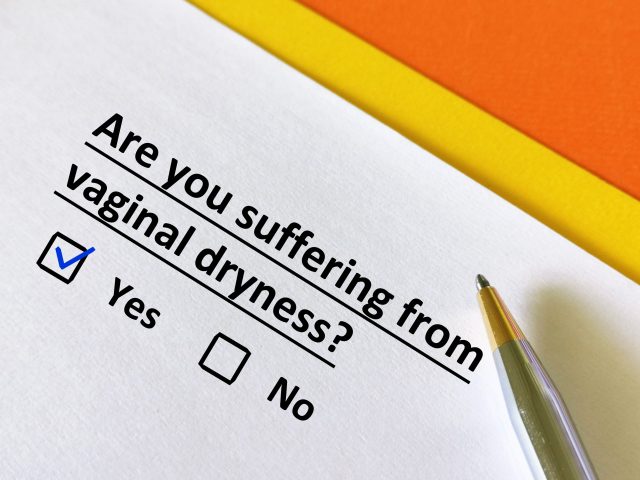
Kate’s Question: Hi, I’ve been doing extensive research and I came across your site. I don’t know if you’re still responding to email questions or not, but I thought I’d give it a try. I just completed my first year of no periods. Dryness, I have the beginning of atrophy, is really my only issue. But I was given 50/50 ratio Biest, one gram a day. I do that vaginally as an insertion for two weeks, and then I reduce it to two times a week after that. I don’t do any progesterone, but this is what my experience has been. After the first full week, I started bleeding. After the second week, it became heavier bleeding. So then they put me on it for a third week and I was supposed to drop down my Biest 50/50, but I continued bleeding. So, I do feel great. And now it’s week four, and the bleeding is starting to taper and I’m loving this but worried about the bleeding. So just wondering your about your thoughts. Thank you, Kate.
Short Answer: With our patients, we don’t use Estradiol vagainlly in order to minimize any unwanted spotting or bleeding. We only use Estriol for vaginal use as it is a “weaker” hormone and less likely to cause any bleeding issues.
PYHP 109 Full Transcript:
Dr. Maki: Hello everyone, thank you for joining us for another episode of the Progress Your Health Podcast. I’m Dr. Maki…
Dr. Davidson: And I’m Dr. Davidson.
Dr. Maki: So we have a lot of questions to do. We have, it seems like we just keep getting more and more and more. So we really apologize that we’re not able to keep up with is as many of them as they keep coming. I think it’s a good thing. Alright, we have an unlimited amount of content to talk about. We are gonna dive in. This is Kate’s question. We are changing everybody’s name just to keep it, you know, just to keep it you know. So no one’s, there’s no identifying information. So if you did submit a question, we might have answered it or we were probably going to answer it but the name might be different so you might have to actually pay extra attention to the podcast. So Dr. Davidson won’t you go ahead and we’ll just dive in.
Dr. Davidson: All right, let’s dive in. So this question is from Kate. So, ‘Hi, I’ve been doing extensive research and I came across your site. I don’t know if you’re still responding to email questions or not, but I thought I’d give it a try,’ and this is why we do get a lot of email questions. We get a lot of, lot of questions on the website, but we want to do them for everybody to listen because it actually all this really applies to a lot of people. So, okay, just to continue with Kate here, ‘So I just completely…’
Dr. Maki: Oh sorry, that’s the copilot. Our co-host Bob is playing with his antlers, deer antlers. So sorry about that.
Dr. Davidson: And he loves to talk and make lots of noise. So if you hear that in the background, that’s Bob.
Dr. Maki: We tried, we tried to, like, edit around that or edit it out and stuff. And then he just every time when we sit down for a podcast, he goes a little bit crazy. So we just kind of forget about it.
Dr. Davidson: How can we not have him in the room with us? I mean, he’s just adorable. Okay, so to continue with Kate, ‘So I just completed my first year of no periods. Dryness, I have the beginning of atrophy, is really my only issue. But I was given 50/50 ratio Biest, one gram a day. I do that vaginally as an insertion for two weeks, and then I reduce it to– oh and, for two weeks, and then I do two times a week after that. I don’t do any progesterone, but this is what my experience has been.
After the first full week, I started bleeding. After the second week, full week, it became heavier bleeding. So then they put me on it for a third week and I was supposed to drop down my Biest 50/50, but I continued bleeding. So, I do feel great. And now it’s week four, and the bleeding is starting to taper and I’m loving this but worried about the bleeding. So just wondering your about your thoughts. Thank you, Kate.’
Dr. Maki: Well, to be honest, this is something that, actually this type of question. We’ve done a couple of like these already but this one comes up over and over. So I have a, I have a few ideas about this and I think you and I are going to probably say exactly the same thing. Well, what’s the first thing that comes to mind?
Dr. Davidson: Well, of course, you know, she’s being given estrogen therapy and she has a uterus. So really she does need some progesterone. That’s about that’s probably, precisely where that bleeding’s coming from. She hasn’t had a period for 12, you know, 12 months. So for a year, so giving that estrogen obviously is a direct cause to cause that bleeding.
Dr. Maki: Yeah, right. Now, granted the dosage one milligram is not a lot, but at the same time, you probably wouldn’t necessarily want. And this is also why we don’t typically add any estradiol into a vaginally, used cream like that. Because you know, for exactly this reason, the estradiol tends to be a little bit too strong, which is why we only use estriol in a case like that.
Dr. Davidson: Yeah, if you’re just going to give somebody some vaginal estrogen for atrophy or dryness or pain with intercourse or irritation with intercourse. That and that seems to be really Kate’s only issue going on, which is awesome and remarkable. But then, yeah, we would just do an estriol or an E3 because it’s so much more gentle. It doesn’t necessarily go into the bloodstream as much. It doesn’t cause that thickening of the lining. Now what probably happened is like, Dr. Maki said, is you think ‘Oh, one milligram of Biest isn’t a lot,’ but they’re doing a 50/50 ratio.
So that means there’s point five milligrams of estradiol, to point five milligrams of estriol there. And I can see where they’re having them do it frequently or having Kate do it frequently and then reducing it down to just twice a week. So they’re thinking, ‘Oh, you know, it wouldn’t be too much estrogen to create that lining to thicken,’ but everybody’s different. She might even have some fibroids that she never knew she had. A lot of us have fibroids in our uterus. We don’t even have any symptoms or know we have it, but that estradiol aggravated those fibroids and causing a continuous chronic bleed here.
So I do agree with Dr. Maki if we’re just looking at more of a vaginal application for atrophy, for irritation, for dryness. Just trying to get that resiliency of the tissues and that, you know, and get that, you know, stimulation more blood flow. You know, we would just probably dial it back to a higher dose of an estriol only.
Dr. Maki: Yeah, now just for an example. So we typically do for something like for this exact issue we’ll do like let’s say four milligrams per gram. She’s doing one. We’ll do four milligrams per gram of an estriol cream. So e3 only, no Biest, just e3 estriol. And every compounding pharmacy has something like that. But then we will have them apply a half a gram. So, half a gram would be half of the four milligrams. So they’re only applying two milligrams at night. And then in the beginning, just like she’s doing, we’ll have them do it for one to two weeks, every night, one to two weeks. And after that every other day and then eventually, a woman knows her body better than anybody. She’ll probably relinquish to something like one to three times a week after that, right?
Dr. Davidson: Yeah.
Dr. Maki: Usually it’s kind of how the, how that process typically goes.
Dr. Davidson: So that’s what we would do for that vaginal dryness and that wouldn’t have really necessarily an effect overall in her bloodstream. So it wouldn’t raise up those estrogen levels too much and at the same time, that’s not going to thicken the endometrial lining or irritate any pre-existing fibroids if they’re in there. Now, on the flip side, let’s say it just wasn’t only the atrophy that was or dryness that was bothering Kate that maybe you know, maybe she’s having some hot flashes, some night sweats, some trouble sleeping, maybe some mood or libido issues or mental energy. Then you might say oh, you know what, something looks like you’re having some other maybe perhaps menopausal symptoms that we want to treat. So then if somebody wanted to give one a Biest that does have the estradiol with estriol and they have a uterus, we’d want to do the progesterone as well.
Dr. Maki: Yeah, right. Yeah. So this is where you when you’re trying to address something locally, it doesn’t typically have too much of a systemic effect except for like you said, the proximity of the uterus. You know, they are so, you know they are so, obviously, the vagina and the uterus are so close to each other. And now granted, she’s a year out from having her period. The closer a woman is to her menstrual history, the more likely the bleeding is to happen. So that’s where you might actually have to use progesterone just because of that fact, no matter what she does, even with the estriol she could still have bleeding.
So, she would be kind of, in some ways forced to use progesterone, which is kind of our, because of the uterus we usually do that. Anyways, and like you’re saying, if she had some of those other menopausal symptoms, surprising she doesn’t have those, yet. She probably will at some point then she has to separate those who she has a Biest for systemic issues, hot flashes, insomnia, night sweats, and then she has a localized e3 cream for this particular issue. And then of course the progesterone, at the same time, to prevent the bleeding issues.
Dr. Davidson: Exactly. So I hope that wasn’t too complicated. I do agree with Dr. Maki that if you’re if you’re treating some overall menopausal symptoms, you can do a Biest that would be kind of that treating over the overall picture, but you would need possibly a separate estriol for the vaginal tissues. And that’s because sometimes when you’re treating someone with Biest for just menopause symptoms, those vaginal tissues are last in line to be able to have that biased for them. So, they tend to have a little that dryness anyway, so you have to have that separate. Everybody’s a little different, not everybody needs the estriol and some people do. So you can see that but anytime you’re doing a Biest, anything that has an estradiol like I said, and you have a uterus you got to use that progesterone. So it would probably be a little bit more, you know, just looking at Kate’s question. The fact that she bled so much as I really feel that that’s coming from the estradiol. I know. Dr. Maki had mentioned something about the estriol could cause bleeding. But to be honest, I have rarely, rarely ever have seen estriol cause any kind of a period or a bleeding. I’ve seen it sometimes cause maybe they might notice if they’re doing a little bit too much estriol. Maybe a little puffiness or sometimes, you know, estriol helps wonderfully with the mood. So sometimes they noticed something changing with their moods, but I’ve never seen an estriol only cause any kind of bleeding, truly.
Dr. Maki: Yeah, right. No, that’s exactly why we use it for this type of application because it doesn’t cause the bleeding where the estriol or the excuse, excuse me, the estradiol almost always does. And that’s why we separate them, we don’t necessarily combine them together because no matter what even if it, the ratio is an 80/20 or a 70/30 or whatever, that estradiol is just too strong to be used in this type of fashion. So definitely one that comes up all the time. You know, the prescribing physician should know better than that, right, you know, honestly, this does come up quite often and there’s nothing wrong with, you know, with Kate. It’s not that she’s not tolerant or anything like that, it’s just the wrong kind of prescription, you know.
Dr. Davidson: So, you know, for Kate, like she said, she’s feeling great and she loves this. So it’s obviously helping that vaginal atrophy and dryness. But at the same time, if you’re bleeding all the time. Because a lot of times, okay, you know, we have some atrophy, we have some dryness and so then intercourse is painful so we want to correct that with some type of estrogen therapy. But if you’re bleeding all the time, it’s not to have intercourse in your period at the same time and especially to have that chronic bleeding. So I could see where, you know, we definitely want to nip that in the bud. Even though she says it’s starting to taper, there is a chance that it would come back or she’d have this sort of out-of-sync bleeding. You know, going, you know, going to the highest intervention, I would say with Kate at this point probably doing a transvaginal ultrasound to see if, you know, there is a thickening of the lining that we want to thin down. And I really think with having this response to this, which is common, but to have it for so long and more of a heavier bleed. I bet there’s some fibroids, a fibroid or two in her uterus that’s being activated by the estradiol, and it’s good to know. Fibroids are completely benign. They’re not cancerous, but they can act like little gremlins and cause bleeding and cramping and you know, out-of-sync bleeding and more periods. So I would definitely think doing probably a transvaginal ultrasound just to just to look at that for her would be a great thing.
Dr. Maki: Yeah. I mean, let’s be honest. There’s a lot of times when you’re when you’re using hormones and there’s bleeding that’s kind of par for the course, right? That’s a very common thing. It doesn’t mean anything’s wrong or doesn’t mean anything serious. It just means that dosing-wise, something needs to be fixed or adjusted. Either the estrogen dose needs to go down or be changed or the progesterone needs to be either added in, and this case, or it needs to be increased. No, now like you said having because there’s so much bleeding for a number of weeks. Probably, a vaginal, a transvaginal ultrasounds not a bad idea. Typically, we don’t run into these kind of issues necessarily right off the bat. So we don’t jump to the transvaginal ultrasound right away. But in her case we would never, this never would have under. This never would have happened, if she would have come to us because we would have kind of been prepared for that and would have accounted for that. So we probably wouldn’t do a transvaginal ultrasound. But because we’re not really aware of all the details, just what she told us in the email. That it probably wouldn’t be a bad idea. Just like you said there was so much, so quickly. Now, it’s tapering off because her frequencies going down but this could have been completely avoided in the first place.
Dr. Davidson: But I love the fact that she’s using the Bio-Identical estrogen. Biest is a bio-identical estradiol and estriol. Looks exactly like what we would make in our own body. So I love the fact that she’s open to using that, that she has a practitioner that’s opening to prescribing that. It’s just like Dr. Maki said, the dose needs to be adjusted, something needs to be changed. But at the same time, there’s so many ways to change things and she can still love it and feel great, but not bleed.
Dr. Maki: Now, this was another question. I’m just kind of throwing in here for a second. Someone made a comment about estriol not being FDA approved. And that’s actually not correct. Estriol is FDA-approved. Otherwise, it wouldn’t be able to be used as a prescription. It is FDA approved. There’s just no commercial medications that at least in America anyways, I know I made that statement one time and someone from England or something chimed in real fast on a comment on the website and said, oh there’s Ovestin or something like that over the counter, or by prescription, you know, across the pond. But in America there is and I believe even Canada, maybe Canada is different, I don’t know. That there’s no commercially available estriol cream.
Every time you get estriol it has to come from a compounding pharmacy. So given that fact it is still FDA approved. There’s just no commercial drugs or all the commercial hormone replacement products on the market are all estradiol. And honestly, you know, that sometimes. Now we use estradiol but we use it always from compounding pharmacies, but the commercial ones tend to be really, really strong. In this case, we want the weaker hormone because it actually has the benefit of not causing excessive bleeding.
Dr. Davidson: Now, if any of you have seen estriol over the counter, and there is companies that make it over the counter. Technically, it’s supposed to be a prescription. There are some companies that are reputable and some that aren’t. So you just have to be careful of what you’re, what you’re buying.
Dr. Maki: Yeah, you’re buying something from Amazon. No offense, again Amazon, we live in Washington, but it is…
Dr. Davidson: We love Amazon.
Dr. Maki: …but at the same time, be very careful of what you’re buying on Amazon. We don’t, we don’t really endorse any of those things on there, necessarily just because, we don’t know who’s making it. Or, you know, that can be, that can be kind of a, you don’t know the manufacturer, you don’t know what’s being produced or what their raw materials are. Then, you know, that can be. You know, because it is a hormone it needs to be taken you know, serious, you know. And especially if you’re using it for vaginal use with the proximity of the uterus there, you know, you want to be careful with that.
Dr. Davidson: Yeah, so just be careful what you’re putting on or in your body but other than that, we use Amazon a lot.
Dr. Maki: Well, yeah, the Amazon got the UPS has shown up in the house like, you know, every single day. We were the frequent flyers Amazon, but, but, you know, I think with, especially now these times, I think everybody is, I mean, everybody’s has kind of, in some ways, kind of forced to do the same.
Dr. Davidson: Online ordering, exactly.
Dr. Maki: Yeah, yeah, yeah.
Dr. Davidson: Almost too much fun. So, we have, you have a book coming out fairly soon. The Perimenopause Plan. We actually have a name. I’m not sure if we’ve announced that before. We are still working out some of the design and formatting. So that’s going to be coming up fairly soon. Really excited. Maybe I know you mentioned before, little nervous about that but still very excited about that. So we’ll keep you up to date on when that actually goes live on, on Amazon KDP.
Dr. Davidson: On Amazon.
Dr. Maki: …yeah, on KDP, Kindle Kindle, Direct publishing. And as always if you have any other questions, we encourage you to send us an email. [email protected]. [email protected]. This is, you know, that way you can keep it discreet. It comes directly to my inbox. And I’ll like I said, we have lots of emails so we do kind of pick and choose, unfortunately. I’m not discouraging you from seeing an email but at the same time compliments go a long way. And you know, we do encourage you to keep sending emails because for 2021 we’re making a making a good push to get to as many of those questions as possible. Whether it’s in one podcast by itself or we start combining a couple questions together into one podcast. So that way we can, you know, we can reach as many people as possible ’cause like you said earlier, this question applies to probably hundreds of thousands if not millions of women that, you know, have gone through this issue or at least nervous about it or concerned about it, or had it happen in the past. And now we’re giving we’re giving Kate an answer. But now, you know, hopefully lots of other people were getting that answer as well, too. So, what do you think about your book? Are you, what are your thoughts?
Dr. Davidson: I’m excited. Like you said, it’s written. It’s done. We’re just getting the design process going. It’ll be. Yeah, it’s very, very exciting, so.
Dr. Maki: Yeah, yeah, yeah. So we’ll keep you up to date on that until next time, I’m Dr. Maki.
Dr. Davidson: And I’m dr. Davidson.
Dr. Maki: Take care. Bye. Bye.
The post Does Estradiol Work for Vaginal Dryness? | PYHP 109 appeared first on .
Discover the common and unfamiliar symptoms that you might be experiencing. Get access to cases of real women with hormonal conditions.

Hormone Coaching App: 👉 http://hormonenavigator.com/ Progress Your Hormones Community: 👉 https://www.progressyourhormones.com/ Menopausal women everywhere are asking the same question: “What’s the RIGHT starting dose for testosterone?” In this episode, hormone experts break down why testosterone dosing is NOT one-size-fits-all, and why starting too high could trigger acne, hair loss, anxiety, or even irreversible side effects. You’ll learn: The safest starting testosterone dose for menopausal women Why some women tolerate higher levels better than others The hidden connection between testosterone, DHT, acne, and hair shedding Why libido problems are more complicated than most people think The truth about pellets vs testosterone cream The side effects doctors watch for FIRST How testosterone impacts motivation, muscle mass, energy, and bone density If you’ve ever wondered whether testosterone therapy could help your menopause symptoms, this episode explains the risks, benefits, and biggest mistakes women make when starting HRT. 🔔 Subscribe for more episodes on bacterial vaginosis, hormones, menopause, heart health, thyroid, and longevity with Dr. Valorie & Dr. Maki. 👍 Like and share this video if it helped you 📩 Comment below with your top takeaway or question Disclaimer: Educational content only; not medical advice. Please discuss your labs and care plan with your clinician.
Hormone Coaching App: 👉 http://hormonenavigator.com/ Progress Your Hormones Community: 👉 https://www.progressyourhormones.com/ Are you taking the right HRT dose… or just the common one? In this episode, we break down a growing problem in hormone therapy: 👉 Younger women are overdosing 👉 Menopausal women are being underdosed And the real issue? Most practitioners treat different hormone types like they’re the same when they’re not. You’ll discover: Why estradiol patches vs creams are NOT equal The hidden mistake when switching HRT types Why “low dose” might actually be hurting you How absorption changes everything Why lab numbers alone don’t tell the full story The real difference between perimenopause vs menopause dosing This isn’t just about numbers; it’s about precision, personalization, and feeling like yourself again. 💡 If your labs are “normal” but you still feel off… this might explain why. 🔔 Subscribe for more episodes on bacterial vaginosis, hormones, menopause, heart health, thyroid, and longevity with Dr. Valorie & Dr. Maki. 👍 Like and share this video if it helped you 📩 Comment below with your top takeaway or question Disclaimer: Educational content only; not medical advice. Please discuss your labs and care plan with your clinician.
Hormone Coaching App: 👉 http://hormonenavigator.com/ Progress Your Hormones Community: 👉 https://www.progressyourhormones.com/ Think menopause ends when symptoms fade? Think again. In this episode, we break down “deep menopause,” a phase rarely discussed but critical for long-term health. While hot flashes and mood swings may disappear, deeper issues like bone loss, muscle decline, insulin resistance, and cardiovascular risk can quietly accelerate. Discover: Why feeling “fine” can be misleading The hidden risks after age 60 How hormone therapy should be approached differently The real reason muscle loss speeds up aging What most doctors overlook about long-term menopause care This is where prevention becomes reversal, and strategy matters more than ever. If you’re serious about longevity, energy, and protecting your future health, this is the conversation you can’t afford to miss. 🔔 Subscribe for more episodes on bacterial vaginosis, hormones, menopause, heart health, thyroid, and longevity with Dr. Valorie & Dr. Maki. 👍 Like and share this video if it helped you 📩 Comment below with your top takeaway or question Disclaimer: Educational content only; not medical advice. Please discuss your labs and care plan with your clinician.
Hormone Coaching App: 👉 http://hormonenavigator.com/ Progress Your Hormones Community: 👉 https://www.progressyourhormones.com/ Is it normal to feel worse years after menopause, even when your labs look fine? In this episode, doctors break down the hidden phase called middle menopause—the stage no one explains, where symptoms shift from hot flashes to something more confusing and frustrating. You’ll learn why: Your cholesterol suddenly increases (without changing your diet) You feel more tired, inflamed, or even pre-diabetic Weight gain seems uncontrollable Intimacy becomes painful Your body no longer feels like your own This isn’t just “aging.” It’s a hormonal recalibration phase that most doctors overlook. Discover the real reason behind: Rising LDL cholesterol Insulin resistance & blood sugar spikes Vaginal dryness and urinary symptoms Increased stress sensitivity despite a “better” life Plus, learn how lifestyle, hormones, and modern tools like personalized hormone tracking can help you take back control. 👉 If you’ve ever thought: “Why do I feel worse now than before?” — this episode is for you. 🔔 Subscribe for more episodes on bacterial vaginosis, hormones, menopause, heart health, thyroid, and longevity with Dr. Valorie & Dr. Maki. 👍 Like and share this video if it helped you 📩 Comment below with your top takeaway or question Disclaimer: Educational content only; not medical advice. Please discuss your labs and care plan with your clinician.
Hormone Coaching App: 👉 http://hormonenavigator.com/ Progress Your Hormones Community: 👉 https://www.progressyourhormones.com/ Are you experiencing symptoms of menopause, but not quite there yet? There’s a confusing phase most women go through that isn’t clearly defined: the transition between late perimenopause and full menopause. This stage is often misunderstood, misdiagnosed, or completely overlooked. What you’ll learn: The REAL difference between perimenopause, “in-between,” and entering menopause Why your estrogen levels suddenly feel like they’ve “left the building” The surprising symptoms no one warns you about (brain fog, night sweats, mood shifts) How your body tries to rebalance itself and why it feels chaotic What your lab results (FSH, estradiol) actually mean during this phase If you’ve ever felt like your body changed overnight or your symptoms don’t match what you’ve been told, this is the clarity you’ve been missing. 👉 Plus: Learn how to track your symptoms and understand your hormonal phase with precision. 🔔 Subscribe for more episodes on bacterial vaginosis, hormones, menopause, heart health, thyroid, and longevity with Dr. Valorie & Dr. Maki. 👍 Like and share this video if it helped you 📩 Comment below with your top takeaway or question Disclaimer: Educational content only; not medical advice. Please discuss your labs and care plan with your clinician.

Hormone Coaching App: 👉 http://hormonenavigator.com/ Progress Your Hormones Community: 👉 https://www.progressyourhormones.com/ You’ve been told your labs are “normal”… but you still feel exhausted, moody, gaining weight, and not like yourself. So what’s really going on? In this episode, we break down one of the biggest misconceptions in women’s health: why “normal” lab results don’t always mean optimal health, especially during perimenopause and menopause. Discover why symptoms like brain fog, poor sleep, weight gain, and mood swings are often ignored… and how traditional lab testing can miss the full picture. We also reveal how tracking patterns over time and combining symptoms with deeper hormone insights can unlock real answers and personalized solutions. If you’ve ever felt dismissed, confused, or stuck… this conversation will change how you look at your health forever. What you’ll learn: ● why normal blood tests don’t show hormone imbalance ● How to read hormone labs in perimenopause ● early signs of perimenopause in your late 30s ● What hormones to test for women over 40 ● why you feel bad even with normal lab results ● How to track hormone changes over time ● best lab tests for female hormone health ● The difference between normal vs optimal lab ranges ● How hormones affect sleep mood and weight ● How to create a personalized hormone health plan 🔔 Subscribe for more episodes on bacterial vaginosis, hormones, menopause, heart health, thyroid, and longevity with Dr. Valorie & Dr. Maki. 👍 Like and share this video if it helped you 📩 Comment below with your top takeaway or question Disclaimer: Educational content only; not medical advice. Please discuss your labs and care plan with your clinician.




